The Signs We Ignore and What Heat Exhaustion Really Means
What Heat Does to Your Dog’s Nervous System. Part 2/3
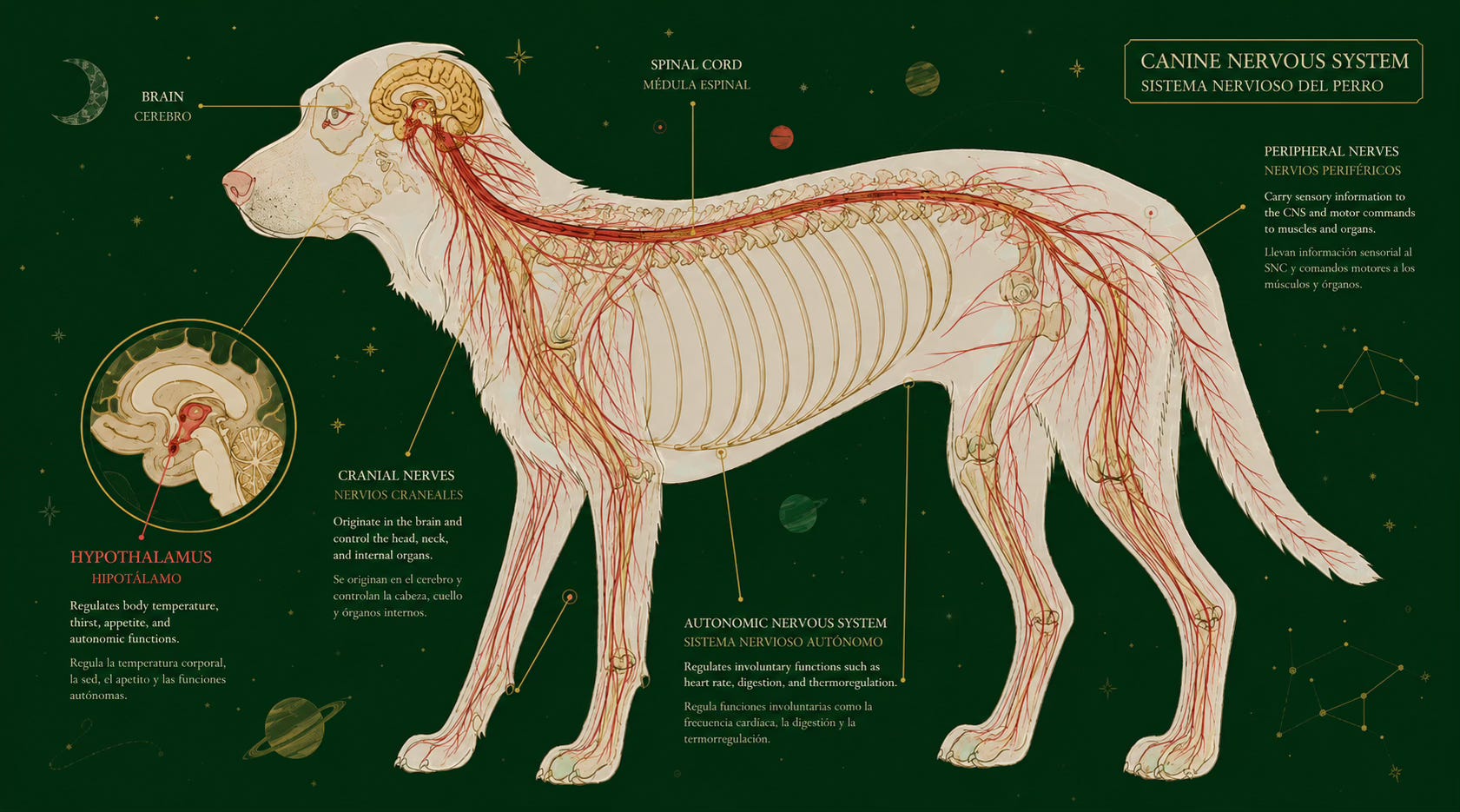
Second installment of the series: What Heat Does to Your Dog’s Nervous System
If you’re coming from Part 1, you already know more about what’s happening inside your dog. You know there’s a thermostat in your dog’s brain that works nonstop to keep them at a safe temperature, and that when heat overwhelms it, a chain reaction begins that affects six organs in order, while they keep walking beside you like nothing’s wrong.
If you haven’t read Part 1, here it is → Part 1
Today I want to talk about something I think is just as important: the signs our dogs’ bodies are sending us when they can’t take it anymore. They’re always talking to us, without saying a word. The problem is that many times we don’t know how to read that language, or we normalize it without meaning to.
And there’s one in particular that moves me deeply, because I’ve seen it more times than I’d like. I’ll tell you about it further down.
Your dog won’t tell you they’re struggling. But they will show you.
Dogs are so noble that they’re not capable of complaining, even when they’re having a really hard time. They have no way of telling you “stop, I feel bad, I need to rest or drink some water.” What they do have is a very clear body language.
The problem isn’t that they don’t speak. The problem is that many times we don’t know how to listen. We don’t stop to observe.
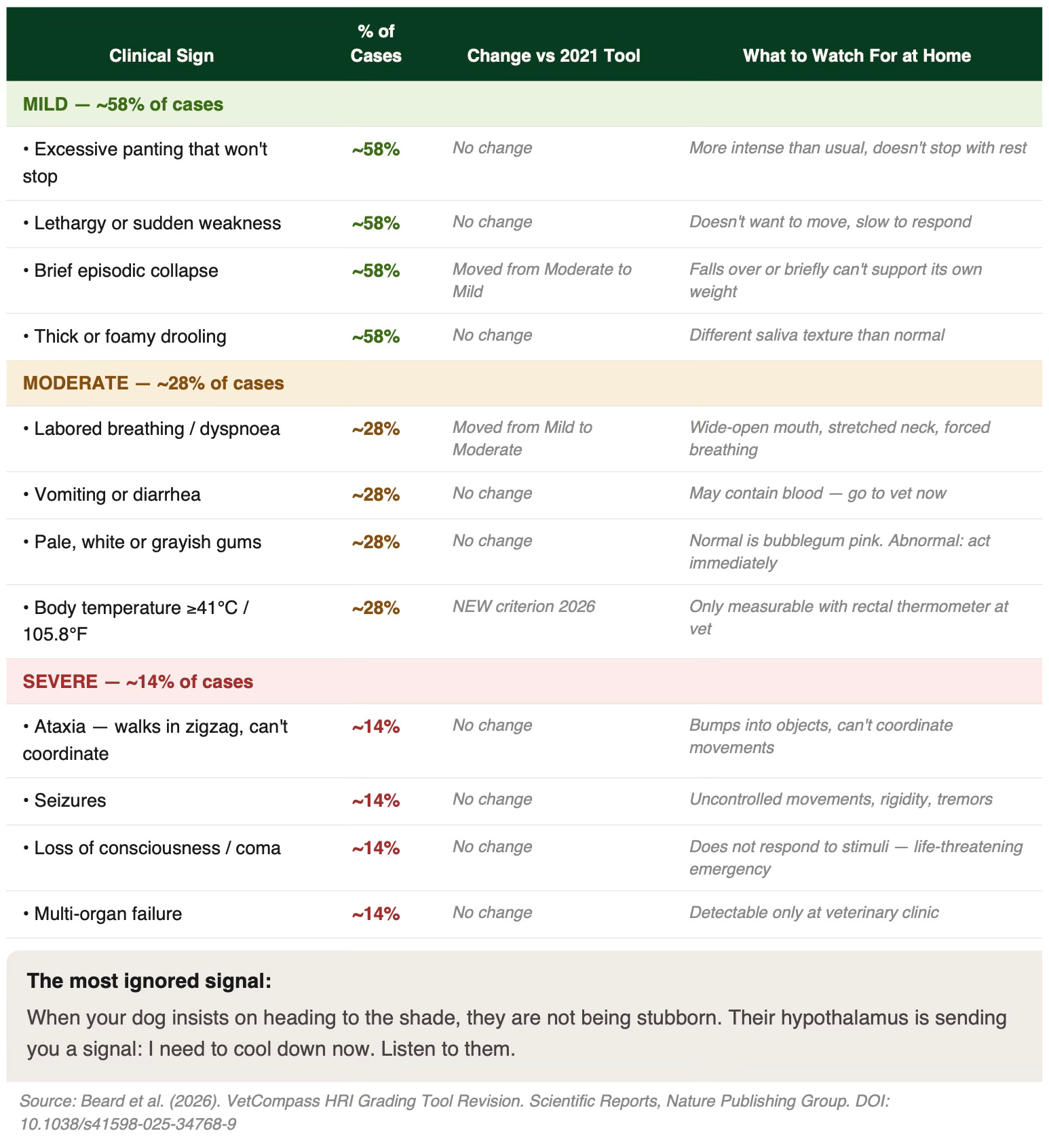
According to the VetCompass 2026 study, the most advanced clinical grading tool in the world for heat related illness in dogs, developed in the United Kingdom with data from 786 real emergency cases, clinical signs are divided into three levels of severity. What struck me most when I read it is that some signs we thought were moderate are actually more or less severe than we believed.
I’ll share them with you one by one, from mildest to most severe.
🟢 Mild Signs (the ones we normalize the most)
These are the most dangerous precisely because they look “normal.” We see them and say “oh, they’re just tired.” And yes, it could be tiredness. But it could also be the beginning of something more serious.
Excessive panting that doesn’t stop even when resting Panting is normal in an active dog. But there’s a difference between panting that comes after playing and panting that doesn’t ease up even after the dog has been still for several minutes. If they’re panting intensely at rest, their hypothalamus is still working at maximum capacity to bring the temperature down. That panting is no longer normal.
Thick or foamy drooling A dog’s normal saliva is thin, as thin as when they drool over a piece of cookie. But when the body is under heat stress, the saliva becomes thick, almost gel like. If you notice your dog’s drool looks different, denser than usual, that’s a warning.
Lethargy or sudden weakness They don’t want to move. They respond slowly. They just stand there looking around with no real interest. This can be mistaken for “tired from the walk,” but if it appears during or after heat exposure, take it seriously.
Brief episodic collapse They fall over or briefly can’t hold themselves up. Here’s something important: according to the VetCompass 2026 study, this sign was reclassified from moderate to mild in the revised version. Not because it’s less important, but because it’s now better understood that it can appear at earlier stages than previously thought. If you see it, act immediately even if they seem to have “recovered already.”
Honestly, I haven’t seen any of these symptoms in Max. Without knowing much about the topic, I’ve always made sure not to expose him to these summer temperatures. Also, I know very well that he’s not a fan of heat, he prefers the cold seasons.
But what I have seen, and can tell you about, is from a time I took Max to the park one April morning. We walked in and there was already a dog lying in the shade, with several people gathered around him. I can’t say for certain if it was due to heatstroke, but it could have been. That dog stayed there the whole time we were at the park, and it wasn’t even that hot of a morning. Just like our own bodies, there are days we can handle certain weather or activities, and other days we can’t.
🟡 Moderate Signs (go to the vet now)
These are no longer “could be tiredness.” These are signs that your dog’s body is under active damage and needs immediate veterinary attention.
Labored breathing Wide open mouth, neck stretched forward, forced and strained breathing. This is different from normal panting. Here the dog is struggling to breathe. Important note: according to VetCompass 2026, this sign was reclassified from mild to moderate because it’s more dangerous than previously thought. If you see this, go to the vet now.
Vomiting or diarrhea Blood may appear. If your dog vomits or has diarrhea during or after extreme heat exposure, don’t wait to see if it gets better on its own.
Pale, white or grayish gums This is one of the things that surprised me most when I learned it. A dog’s normal gum color is bubblegum pink. If they’re pale, white, or have a grayish tone, that’s a sign that the body isn’t circulating blood well. Practice checking your dog’s gums today, while they’re healthy and cool, so you know what they look like under normal conditions. That will let you recognize when something isn’t right. Sometimes it’s the tongue that changes color instead.
Body temperature of 41°C / 105.8°F or higher This is a new criterion added in the VetCompass 2026 revision, and it’s the first time it’s been formally included. It can only be measured with a rectal thermometer at the vet, but it’s important you know this: if you’ve reached this point, you’re in an emergency zone.
Complete chart of clinical signs by category
sign, percentage of cases, change in the 2026 tool, and what to watch for at home
🔴 Severe Signs (immediate emergency)
There’s no time to lose here. Every minute counts.
Ataxia They walk in a zigzag, bump into objects, can’t coordinate their movements. Their brain no longer has enough oxygen to control the motor system. This is a severe sign of central nervous system distress.
Seizures Uncontrollable movements, rigidity, tremors. If you see this, don’t try to hold them down by force. Place them somewhere safe where they won’t hurt themselves and go to the vet immediately.
Loss of consciousness They don’t respond to your voice, your touch, any stimulus. This is a life threatening emergency. Every second counts here.
Multi organ failure You won’t see this from the outside. Only a vet can detect it. This is exactly why acting quickly on the earlier steps can save your dog’s life.
The signal that’s most ignored, and the one that moves me most
Of all the signals out there, there’s one I see ignored constantly, and it hurts me every time I witness it:
When a dog heads toward the shade and isn’t allowed to.
I’ve seen this so often when I go for walks. Dogs pulling toward any tree, any wall, any inch of shade they can find, and their humans pulling them back to keep walking under the sun. No bad intentions, I know. Simply not knowing. But they’re not even given the chance to show what they’re looking for in that moment, we immediately assume they’re just trying to cut across out of stubbornness.
But when your dog insists on heading to the shade, they’re not being stubborn. Their hypothalamus, that thermostat we talked about in Part 1, is overwhelmed and sending a very clear signal: I need to cool down right now.
That’s communication. That’s your dog talking to you with everything they have.
Listen to them.
Thanks for reading. Subscribe for free to receive new posts.
Heat exhaustion is not healthy tiredness, and that changes everything
There’s something I hear often that I want to gently unpack, because I know it comes from a place of love for our dogs, not negligence.
The idea that taking the dog out to run or walk in the middle of the day “tires them out properly” and that’s why “they rest just fine once they get home.”
I understand where it comes from. We have busy lives, we want them stimulated, we want them to sleep well. But what’s actually happening when a dog comes home exhausted from a walk in full sun isn’t that they released energy in a healthy way.
They’re in heat stress. Their nervous system is depleted, not balanced.
-
The first one rested their mind and body naturally.
-
The second one survived the heat.
According to a study on the pathophysiology of heatstroke in dogs published in Tandfonline: “the activation of inflammatory cascades initiates a systemic inflammatory response syndrome that frequently progresses to multi organ dysfunction syndrome.”
In simple words: extreme heat doesn’t just exhaust. It inflames, destroys tissue, and can leave damage that you can’t see from the outside but is there.
And there’s something else I want to add from my own experience with Max: when he comes home from a cool morning walk, he’s present. He’s with me, he sniffs, he explores, he interacts. His panting is controlled, he can pause, breathe through his nose, smell things, and that panting doesn’t last more than 20 minutes. When he’s had to go out during hotter moments, there’s a difference in his energy that isn’t normal tiredness. It’s like something switches off a little, like he’s telling me: “put me in a bath of water, please!” His panting is longer and doesn’t pause. And now that I understand what’s happening in his nervous system, it all makes complete sense.
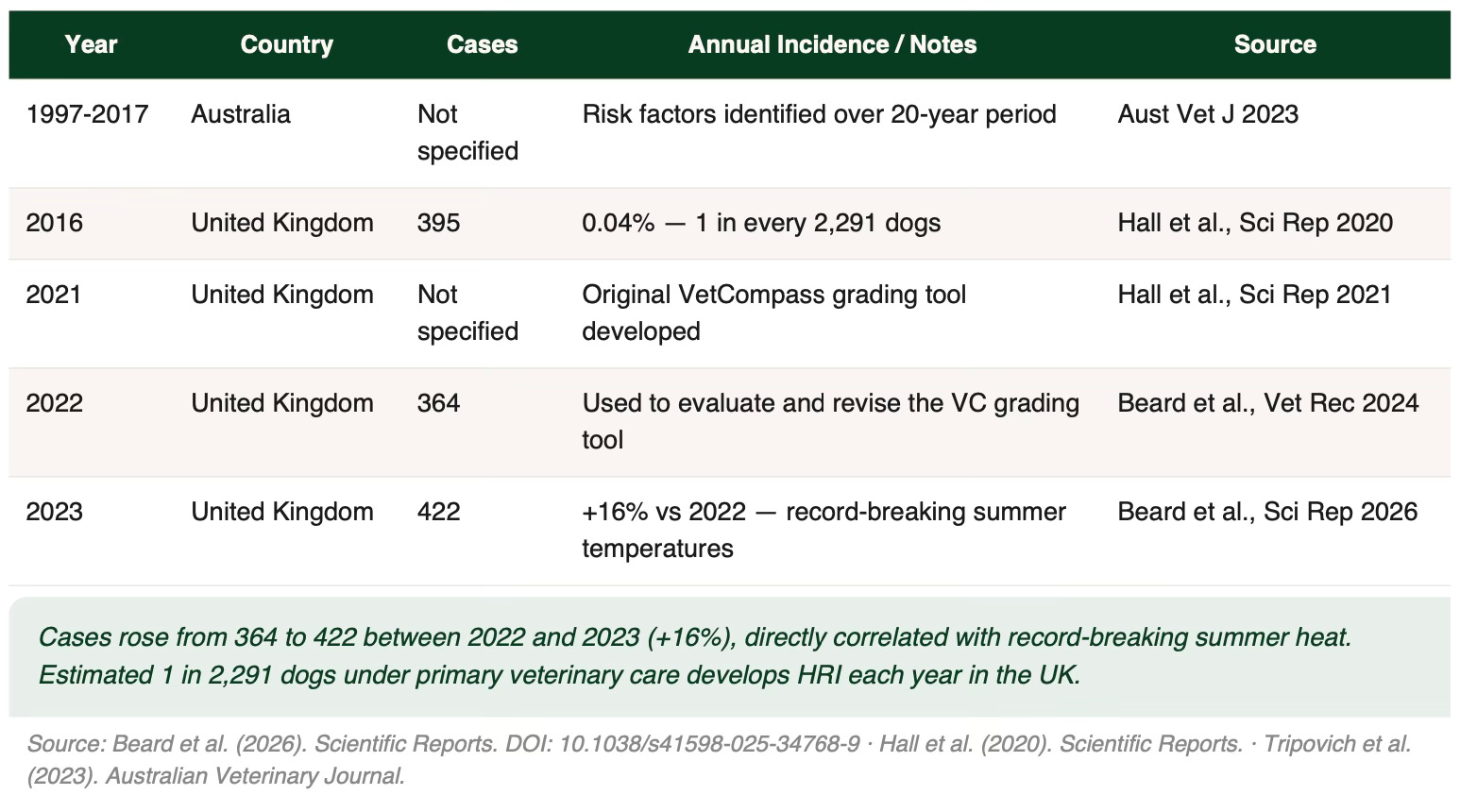
Annual Incidence Risk chart for HRI by year, with data from the VetCompass 2026 study
Before we close: one practical thing you can do today
Learn to check your dog’s gums and tongue today, not during an emergency.
Gently lift their upper lip and look at the color of their gums. That bubblegum pink is what you should always see. Practice it once a week and make it part of your care routine. That way, if their gums ever look different, you’ll know right away.
Also watch their panting, that’s the main thing you’ll notice when they’re feeling hot. Learn what their panting looks like when they’re doing well, so you can recognize when something’s off.
It’s one of the simplest and most powerful things you can do for your dog.
For the next installment
So far we’ve learned what’s happening inside our dogs’ bodies and the signs they give us.
Now: what can you do, practically, so this doesn’t happen to your dog this summer?
That’s what we’ll cover in Part 3. With schedules, with concrete tips, with what I do with Max, and with an economic fact that, when I saw it, left me speechless.
Because sometimes, when it hits our wallet, we think twice.
Part 3 is coming soon.
Read Part 1
Thank you for making it all the way here and for giving yourself this moment to read, reflect, and connect.
I’d love to hear from you in the comments. Did any part of this resonate with you? Did you have any insights or realizations while reading?
This is a space created to nurture a deeper connection between humans and dogs through love, presence, understanding, and awareness. If you’d like to continue this journey with us, I invite you to subscribe and join us in our other spaces as well.
You can also find us on Instagram and Facebook 🤍
Thank you for being here and for being part of this beautiful community.
With love,
Mafer AP
Thanks for reading. Subscribe for free to receive new posts.
Sources for this installment: