What Heat Does to Your Dog’s Nervous System. Part 1/3
The Thermostat and How Their Body Responds
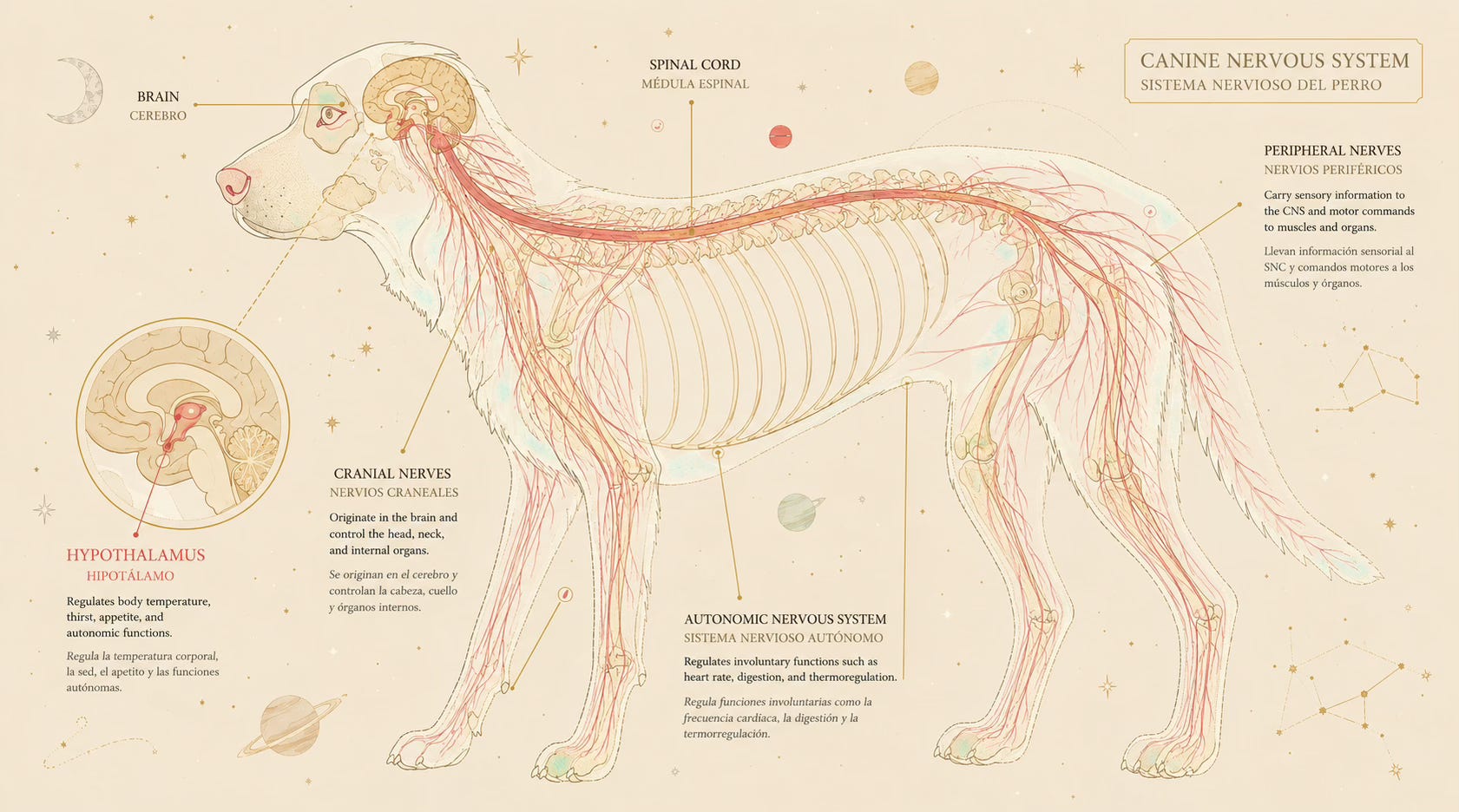
First installment of the series: What Heat Does to Your Dog’s Nervous System
Imagine it’s noon, you check the weather app and it reads 96°F, and someone invites you to go for a run but you have to wear a sweater you can’t take off. No matter how hot you feel, no matter how much you try, it stays on.
That, exactly that, is what your dog goes through every time you take them out for a long walk in the middle of a summer day.
And yes, I know there are people who run or walk in a sweater at those temperatures. I’ve seen them, and that’s totally fine, I have nothing to say about that. But there’s a difference between you having the option to take the sweater off and your dog having no option to take their coat off. And no, the solution is not to shave them, because their coat actually helps regulate their temperature between cold and heat and protects their skin from the sun, so that’s off the table. But there’s something that goes beyond the external heat that I want to share with you today, something I’ve learned over time that has completely changed the way I see summer walks with Max.
Today I don’t just want to talk about “it’s hot.” I want to talk about what’s happening inside (in your dog’s brain, in their nervous system) because that’s what most of us don’t know, and it’s what can make the difference between a healthy dog and a veterinary emergency. And I know that’s the last place any of us want to be.
And I’ll be honest with you: I’m not a veterinarian, not an expert, not a scientist. I’m a person who loves their dog and became obsessed with understanding what happens to them when it’s hot. Max is the one who enjoys a hot day the least. If I took him for a long walk he’d stop dead in his tracks and look at me like: have you lost your mind? I’m not moving from here, don’t even think about asking me to walk in the shade. So everything I share here comes from real studies and veterinary sources. I just translate it into the language of those of us who love our dogs.
Before going into detail, I want you to have this map in your head: when the heat exceeds what your dog’s body can handle, it’s not just one organ that suffers. It’s six, in a chain and in order. The brain is the first to be affected. Then the heart, the kidneys, the liver, the lungs and the intestines. And it all starts in one place: the control center of the brain. Today we’re going to talk about that.
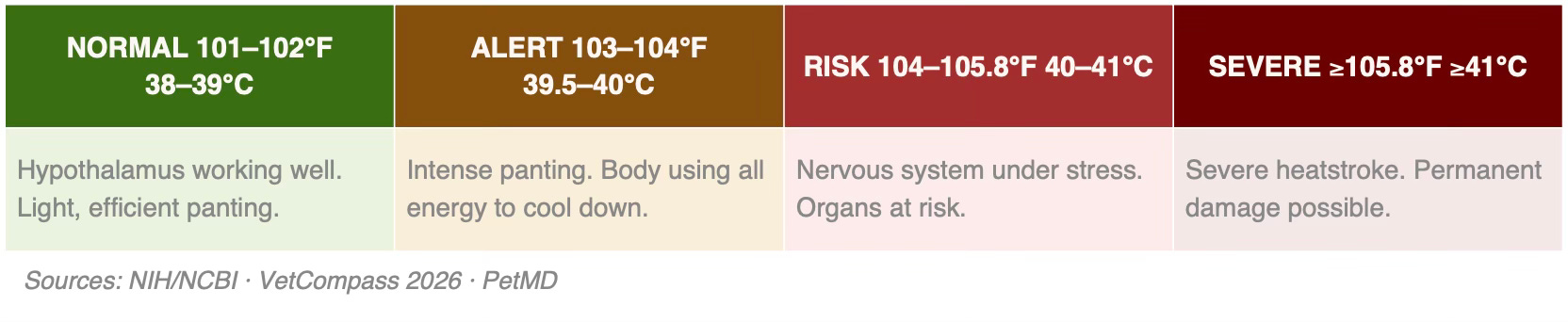
I’m leaving you a super easy chart I made about The body temperature scale in your dog.
The Thermostat of Your Dog: What Is the Hypothalamus and Why Does It Matter
There’s a part of your dog’s brain that works exactly like a thermostat. That’s the hypothalamus. It’s tiny, located at the base of the brain, and it has one single mission: to keep body temperature within a safe range.
According to WorksSOwell, a resource specialized in canine physiology, “the temperature control center is located in the hypothalamus. It regulates body temperature based on signals from cold and heat receptors located in the skin and throughout the body.”
When your dog is hot, the hypothalamus receives that signal and sends one order: pant. Panting is basically the only real cooling mechanism dogs have. We sweat all over our bodies. They don’t.
According to Iowa Veterinary Specialties, dogs have something similar to sweat glands only on their paw pads. Everything else depends on panting, on the evaporation of humid air inside the respiratory system to lower the temperature.
What comes next I definitely didn’t know, and that is: when your dog is panting intensely to cool down, they can’t smell well. And of course, how are they supposed to smell anything when the poor thing is trying to catch air and regulate themselves. Their respiratory system is completely dedicated to surviving the heat, not to enjoying the walk. They’re not exploring. They’re not happily running with you. They’re working at maximum capacity just to keep from overheating.
Thanks for reading. Subscribe for free to receive new posts.
What Happens When the Thermostat Fails
Panting has limits. And when the heat exceeds what panting can handle, a chain of unfortunate events begins that goes far beyond tiredness.
According to PetMD: “when the dog’s temperature exceeds 104°F (40°C), central nervous system symptoms appear such as disorientation, seizures and multi-organ dysfunction. Heatstroke damages heat shock proteins, which are designed to protect the body from stress and heat.”
In simple words: above 104°F, your dog’s brain starts to shut down.
And what follows is more serious. At 41°C (105.8°F), the hypothalamus can suffer permanent damage. Not temporary. Not “it recovers with rest.” It’s permanent.
According to a study published by the NIH (National Institutes of Health of the United States): “ischemic, hypoxic and oxidative damage to the hypothalamus during heatstroke can cause multi-organ dysfunction or failure. Approximately 30% of heatstroke survivors experience permanent disability and neurological dysfunction.”
30%. Three out of ten dogs who survive severe heatstroke are never the same.
And let me explain a little, because I was just like you wondering: what does this mean?
Ischemic damage occurs when less blood reaches the tissues.
Hypoxic damage occurs when tissues receive less oxygen than they need.
Oxidative damage occurs when there is an excess of free radicals, unstable molecules that damage cells, proteins, DNA and generate inflammation.
And all of this internal process is what affects multiple organs, putting the dog’s life at risk.
I’m telling you, reading about how our dogs work on the inside is such a wow moment for me, that’s why I felt the need to share it with you. Here we are learning together.
And it’s not just the brain. As I mentioned at the beginning, it’s six organs in a chain. The brain is the first. But the heart, the kidneys, the liver, the lungs and the intestines also enter the chain. Each one in turn, in silence, while your dog keeps walking alongside you.
In Part 2 of this series we’re going to look at exactly what happens to each of these organs. For now, let’s continue with what amplifies all of this, especially if you’re in countries or states where temperatures are extremely high, like Texas for example.
Your dog doesn’t only receive heat from above. They also receive it from below.
The pavement in summer, when the air reads 90°F, can be between 140°F and 160°F. That’s approximately 60°C under their paws. While you walk with shoes and your body is almost a meter from the ground, your dog walks directly on that surface, much closer to the vapor rising up.
It’s a double exposure: heat from the sun from above and vapor from the pavement from below. With this invasion the hypothalamus gets overwhelmed much faster.
According to the Texas A&M College of Veterinary Medicine, Dr. Gabriela Rivas, resident in emergency and critical care, warns that “heatstroke is a medical emergency because as body temperature rises, different organ systems can suffer serious injuries, including abnormal heart rhythms, coagulation disorder, severe dehydration, systemic infection and seizures.”
The test I always recommend and do when I go out with Max and can’t find shade is to place the back of my hand on the pavement or concrete. If you can’t hold it for 7 seconds, your dog shouldn’t be walking on it.
Please, don’t expose them.
I insist, I look for and share so much information on this topic because even when they put up signs about specific high temperatures for dogs on walking paths to prevent paw burns, I still see many people taking their dogs out to run or walk during extreme hours. That can be between 12 and 3 in the afternoon, at that hour it is horribly hot for a dog, sometimes temperatures are 105°F!! It’s total madness!
I’ve seen so many dogs trying to reach the shade, but their human simply won’t let them, insisting on continuing to walk under the sun. And yes, I understand that sometimes you want to take advantage of the walk to get some sun or exercise. Perfect. But for that, go alone. Your dog doesn’t need that unnecessary heat stress.
Our dogs will always want to come with us everywhere, yes, they’ll never say no, but you’re the one who knows if it’s too hot to expose them to those conditions for that long.
If what you’re looking for is for them to arrive home tired, there are much better and safer ways to do it. Inside the house, nice and cool, with scent games or movement games. That kind of tiredness is the healthy kind.
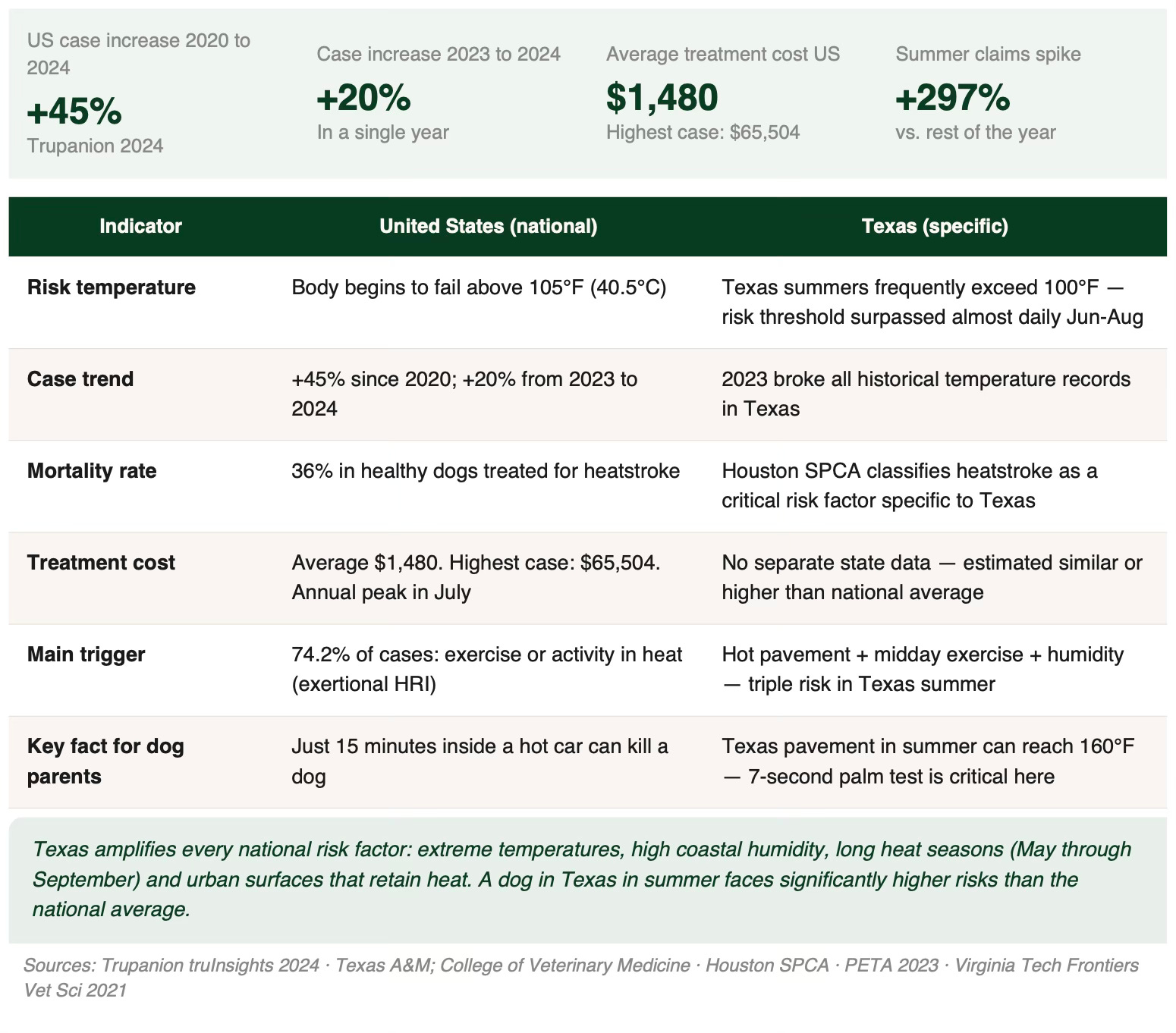
Here I’m also leaving you a comparative chart between the US vs. Texas.
Yes, Texas is part of the US, but Texas presents conditions that amplify all national risk factors: extreme temperatures, high humidity in coastal areas, long heat seasons (May through September) and urban surfaces that retain heat. A dog in Texas in summer is exposed to significantly higher risks than the national average.
Comparative chart US vs Texas (incidence, mortality, treatment cost, risk temperature.
For the next installment
Now that you know what’s happening inside, in your dog’s brain, the next question is: how do you know in time? What are the signs your dog is giving you that many of us ignore?
That’s exactly what we’ll cover in Part 2.
Thank you for making it this far and for giving yourself this moment to read, feel, reflect and connect.
I’d love to read your thoughts in the comments. Was there a part that resonated with you? Did you have any reflection or discovery while reading?
Was this first part useful? Save it and share it with someone who has a dog.
Part 2 is coming soon.
This is a space created to nurture a deeper connection between humans and dogs through love, presence, understanding and awareness. If you’d like to continue on this path with us, I invite you to subscribe and join us in our other spaces too.
You can find us on Instagram and Facebook as @hi.mr.doggy 🤍
Thank you for being here and for being part of this beautiful community.
With love, Mafer A.P.
Thanks for reading. Subscribe for free to receive new posts.
Sources for this installment:
-
WorksSOwell. Temperature Regulation of the Dog. workssowell.com
-
Iowa Veterinary Specialties. Canine Heat Stroke Literature Review
-
NIH/NCBI. Ischemic and Oxidative Damage to the Hypothalamus. PMC3637668
-
Texas A&M College of Veterinary Medicine. Dr. Gabriela Rivas, 2023
Thanks for reading. Subscribe for free to receive new posts.