How to Protect Your Dog This Summer, and the Number Nobody Wants to See
What Heat Does to Your Dog’s Nervous System. Part 3/3
Third and final installment of the series: What Heat Does to Your Dog’s Nervous System

This series was deep and full of incredibly valuable information, from which I learned so much. Now we get to the practical part: what we can actually do.
If you read Part 1 → about the hypothalamus and the chain of damage, and Part 2 → about the signs many of us ignore, you already have something most humans with dogs don’t: real context about what’s happening in your dog’s body when the heat spikes.
Now let’s use that context to make better decisions. No fear, no guilt. Just information.
Concrete things you can do this summer
Schedules matter more than distance. Two safe windows each day:
-
Before 8am
-
After 7:30pm
Outside of those hours, the ground burns and the air drains. A 20 minute walk at 7am is worth infinitely more than an hour long one at 11am.
Water isn’t optional, it’s urgent. But little by little. Keep fresh water available at all times, even during the walk. But careful: if your dog is very hot, don’t give them water all at once. Offer it gradually. A sudden change in internal temperature can also cause problems.
Shade is medicine. Walking on shaded surfaces (grass, dirt, sidewalks covered by trees) significantly reduces exposure to pavement vapor. A block in full sun is not the same as a park with trees.
Mental play at home is a real option. On days of extreme heat, mental enrichment at home is the best option. Sniffing toys, hiding treats, quality time with you. This tires your dog out in a healthy and balanced way. You don’t need to go out into the sun to have a mentally stimulated and happy dog.
If your dog heads to the shade, take them there. And if they don’t want to move, listen to them. As we talked about in Part 2: those are not signs of stubbornness. They’re signs of a nervous system asking to stop.
📌 What this looks like in my day to day with Max:
On days of extreme heat, Max spends almost the entire day at home. Between 7 and 7:30am we go down for a walk or sometimes to the park. At that hour there’s still enough shade and the sun is gentle, for both him and me.
During the day he sleeps, we play when he asks for it, he picks the toy he wants to play with and we spend about 20 minutes on that. Sometimes I hide little pieces of cookies all over the house, that helps stimulate his brain (he loves that game).
During the day we go down 2 to 3 times for a pee break. I always take him where we can find shade, and if we don’t find shade it’s fine, at least I keep him walking on grass or dirt. It’s just a few minutes during those little outings anyway.
If the day isn’t too humid, we go to the park after 8pm. And if we don’t go to the park, we take a long walk at 9 or 10pm. On those walks we stroll, he sniffs calmly, and sometimes we run, depending on his energy.
Without realizing it at first, I ended up building exactly the two safe windows we talked about in Part 1: before 8am and after 7:30pm. Sometimes intuition and science arrive at the same place.
What I’ve learned is not to expose him on days that are very humid and hot. Those are temperatures that even I can’t handle, so I avoid exposing him. I know he’d want to go out all the time, but he doesn’t know the consequences. I do. So he might spend little moments alone at home, but I know he’ll be better off there than going through an unnecessary hard time.
Before, I used to think that taking him out longer was better for him. Now I know that the right time matters more than the long time.
And now, the number nobody wants to see
If there’s still doubt about whether it’s worth changing the walking routine in summer, there’s a number that sometimes convinces more than any medical study: the price of not doing it.
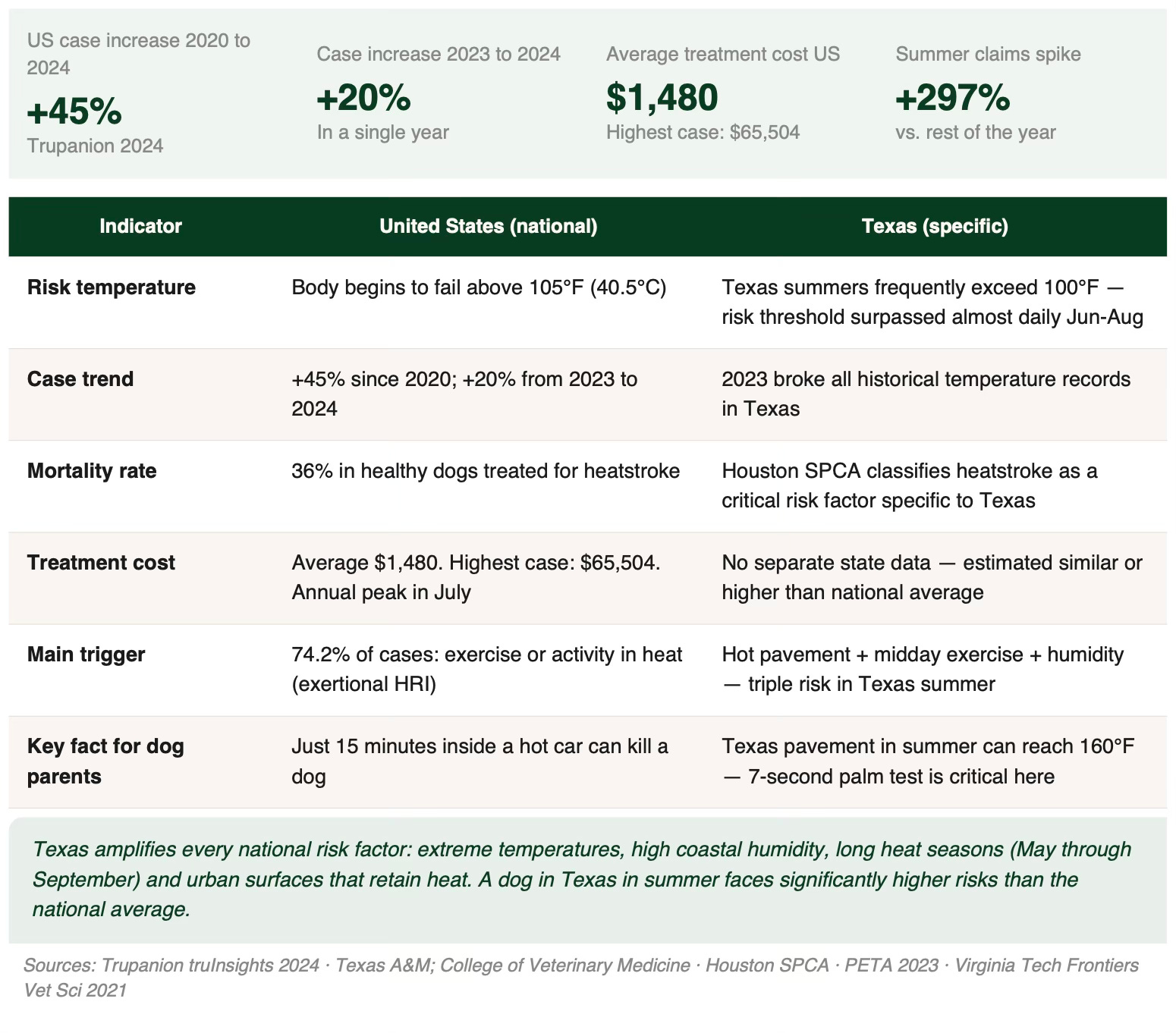
According to Trupanion, one of the largest pet insurers in the United States, heatstroke cases in dogs increased 45% since 2020, and from 2023 to 2024 alone they rose another 20%. The average cost of treating heatstroke in 2024 was $1,480.
But that’s the average.
Trupanion recorded treatment cases that reached tens of thousands of dollars. And the highest documented case was $65,504, for a single severe heatstroke case.
Sixty five thousand dollars.
And to think that all of this can be prevented with something as simple as choosing the right time of day.
Because sometimes, when it hits us hard in the wallet, we think twice. Although it wouldn’t even need to get to that. Leaving your dog at home while you go for a run or a walk isn’t neglect, it’s protection. And there’s nothing like getting some sun yourself at 2pm in 92°F while you exercise, right? And that’s perfectly fine, but do it on your own. You can at least choose to cover up or not, to go out or not. Your dog can’t.
United States vs Texas comparative chart
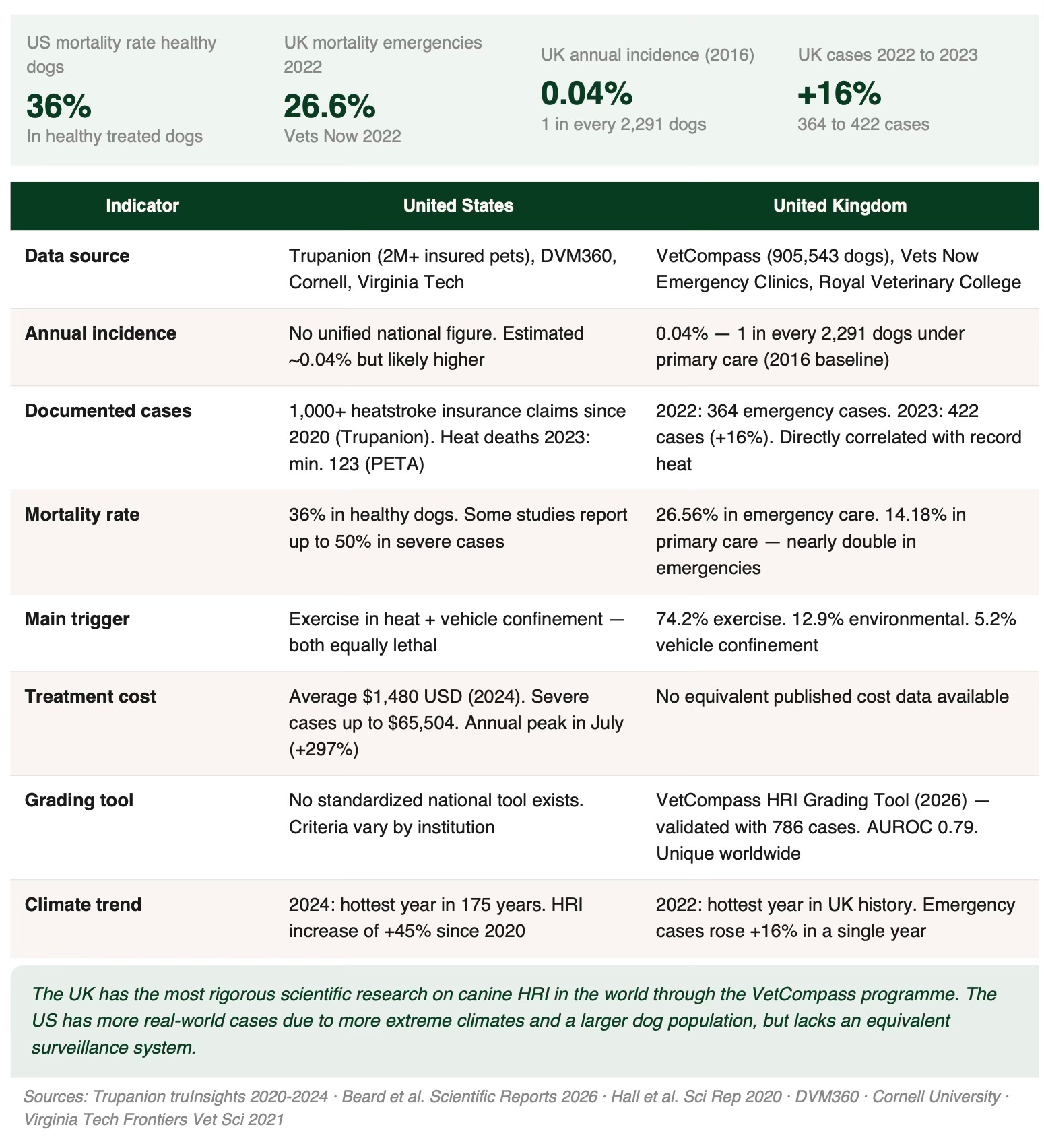
United States vs United Kingdom comparative chart (global research landscape)
One more thing I want to leave you with: how to properly cool down your dog
After talking so much about prevention, it felt important to include something practical for those moments when it’s already hot and you need to help your dog bring their temperature down. Because here too there are very common mistakes that, without meaning to, can make things worse.
The most important thing before anything else: cool gradually, not all at once. And getting them out of the heat matters more than anything else you do.
What to avoid and what to do when cooling down your dog” chart
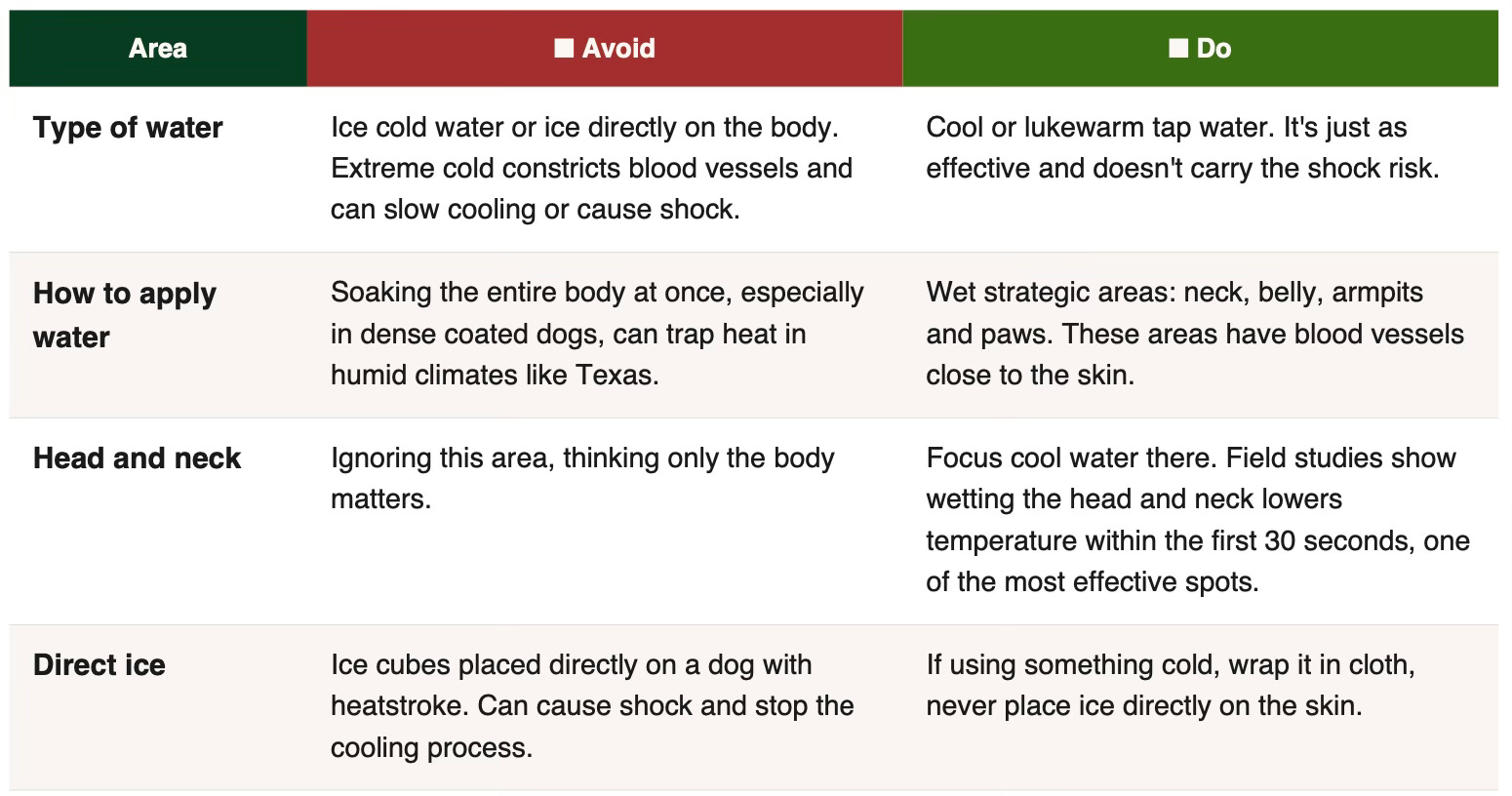
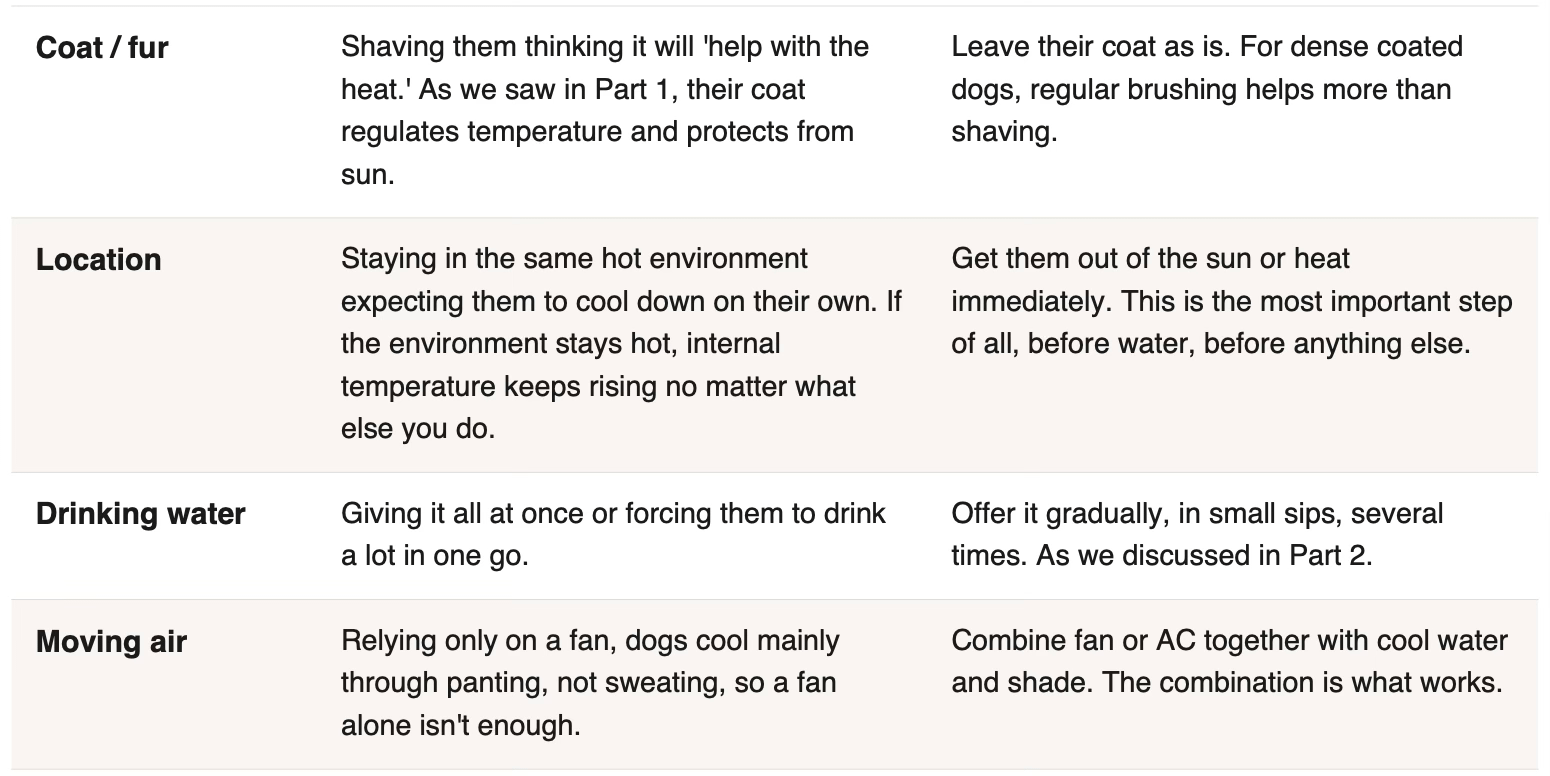

If what you’re seeing are moderate or severe signs from Part 2, this chart doesn’t replace the vet. It’s what you do on the way there.
The phrase that stuck with me most from all this research is: “cool first, transport second.”
Cooling your dog before arriving at the vet can increase their chances of survival from approximately 50% to 80%.
And after a heatstroke episode, even if they seem better, keep them in a cool environment for at least 24 hours. Internal damage can still be happening even if they look fine on the outside.
To close this series: one thing I want you to remember
If there’s something I took away from everything I researched to write this series, it’s this:
If you’re hot, your dog is hotter. It sounds obvious, but we ignore it.
They don’t sweat like we do. They only release heat through their paw pads and panting. They’re closer to the ground than you are. And their nervous system, that hypothalamus that works nonstop to keep them at a safe temperature, has a real, physiological, documented limit.
Your dog will always want to come with you. They’re curious, they’re explorers, they’d do anything to be by your side. That’s what makes them beautiful. But wanting to doesn’t always mean being able to.
And one of the deepest ways to love them is knowing when to say: today we stay home.
If I hadn’t taken the time to observe Max and truly pay attention to his lenguage body, I wouldn’t have reflected on the care he deserves, the attention, and protecting him from things like not walking on asphalt or concrete during the hottest hours.
Because of course, I wear shoes and don’t notice, but he doesn’t have that, so he can feel everything and burn his little paws if I’m not present for him and present in my surroundings.
Every summer I learn something new, and this time it was understanding how his nervous system works under heat, which makes me take a lot more precautions than I already had with him.
For many this will seem excessive, but for me it’s about being more aware that he’s a being who feels, and who is impacted differently than I am by heat. Max is my son, and I’m 100% responsible for him, so I take his care seriously.
So, let’s be the moms and dads they need this season.
The ones who listen when they seek the shade.
The ones who notice when the panting is no longer normal.
The ones who say “today we stay” even when they want more.
It’s not exaggerating. It’s understanding what their body can’t tell you with words.
If this series was helpful to you, save it in full and share it with someone who has a dog. And if you have questions about your furry friend’s wellbeing, I’d love to hear from you.
Full series:
-
Part 1 → “Your dog’s thermostat, and why panting has a limit”
-
Part 2 → “The signs we ignore, and what heat exhaustion really means”
-
Part 3 → “How to protect your dog this summer, and the number nobody wants to see” ← you are here
Thank you for making it this far and for giving yourself this moment to read, feel, reflect, and connect.
I’d love to hear from you in the comments. What’s your summer walking schedule? Tell me, I’d love to learn about other dogs’ routines.
This is a space created to nurture a deeper connection between humans and dogs through love, presence, understanding, and awareness. If you’d like to keep walking this path with us, I invite you to subscribe and join us in our other spaces too.
You can also find us on Instagram and Facebook as @hi.mr.doggy 🤍
Thank you for being here and for being part of this beautiful community.
With love, Mafer A.P.
Thanks for reading. Subscribe for free to receive new posts.
Sources for this installment: